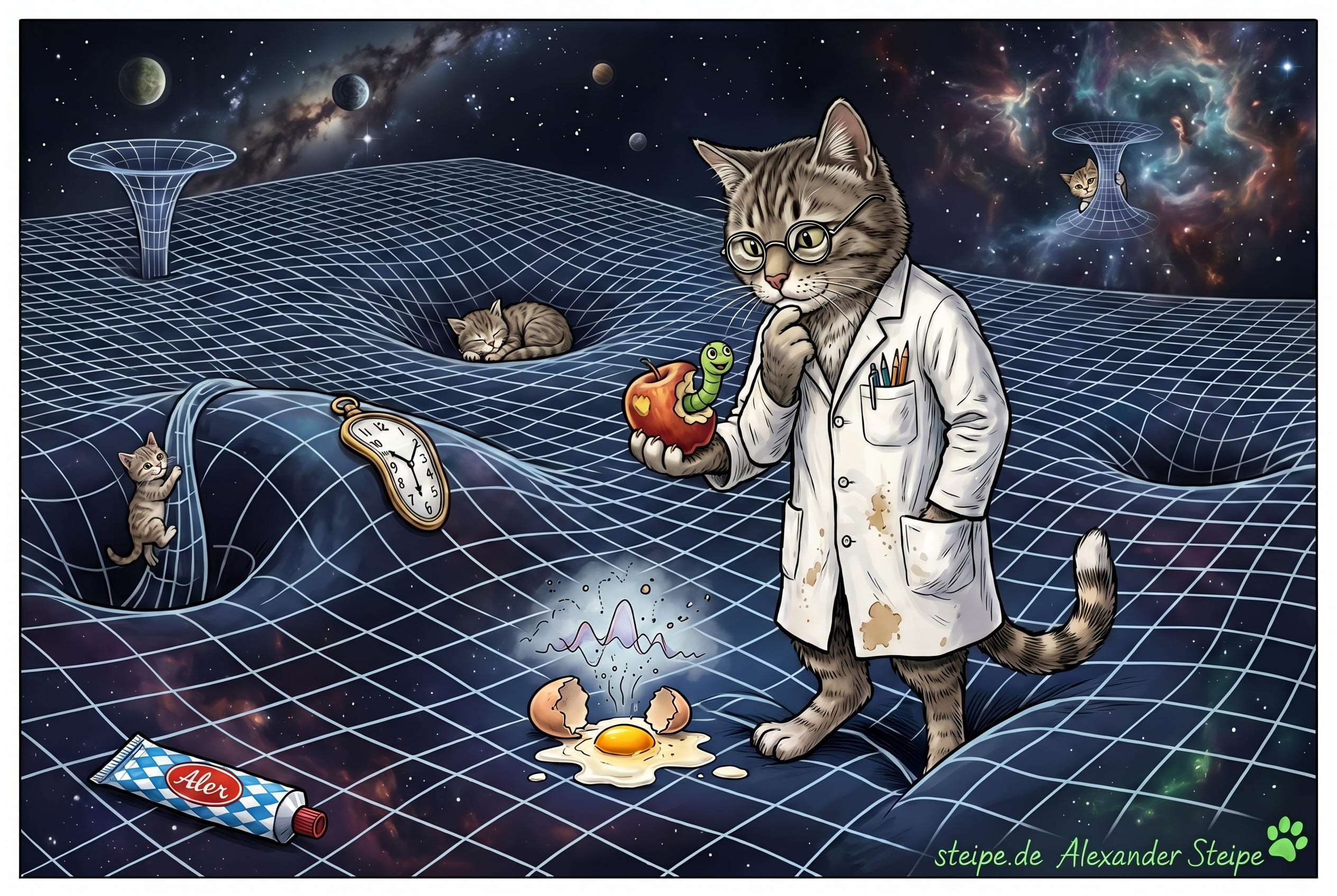
An elastic grid curving under mass, melting clocks, wormholes, and seemingly impossible gestures: This visual motif bundles fundamental principles of modern theoretical physics into a single surreal scene.
At its core lies Albert Einstein's General Theory of Relativity. Spacetime acts not as a rigid container, but as a dynamic four-dimensional continuum. Masses deform this fabric into gravitational wells, while extreme topological warps—visible as funnels—hint at Einstein-Rosen bridges (wormholes) acting as cosmic shortcuts. The melting clock illustrates gravitational time dilation: in intense gravitational fields, time ticks demonstrably slower.
Entropy, Mustard, and the Thermodynamic Arrow of Time
Simultaneously, the scene visualizes the thermodynamic arrow of time: Both the shattered egg and the Bavarian mustard tube at the lower left symbolize the Second Law of Thermodynamics. Once squeezed out, mustard cannot be sucked back into the tube, just as a broken egg never spontaneously reassembles. In closed systems, entropy and disorder increase irreversibly.
The Quantum Mechanical Paradox
The researcher cat marks the transition into the microscopic realm as a living embodiment of Schrödinger's cat and the principle of superposition:
- The Thinker's Pose: One paw rests pensively on the chin, observing the fabric of reality.
- Newton Meets Wheeler: The second paw clutches the bitten apple—a dual nod to classical gravity and John Wheeler's original wormhole analogy, complete with an actual worm taking a topological shortcut through the core.
- The Wave Function: Simultaneously, an egg has struck the floor, releasing a propagating wave function upon impact.
Much like Schrödinger's cat existing simultaneously dead and alive in the thought experiment, the researcher here resides in an uncollapsed state of superposition. He is simultaneously the detached observer, the measuring physicist, and the causal agent. Created with the aid of generative AI, the image bridges macroscopic relativity and quantum paradox: Only the observer's gaze collapses the probability wave into concrete reality.